
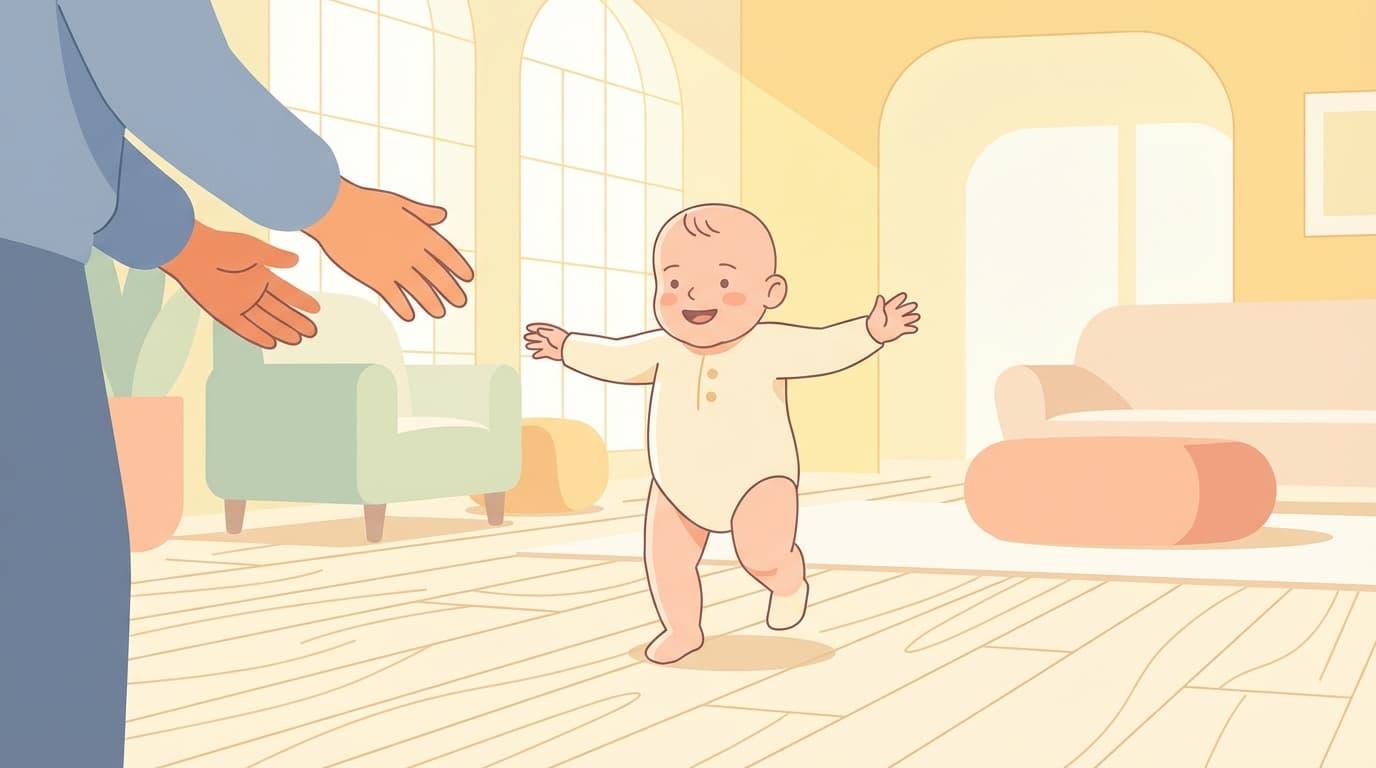
Most babies start walking around 12 months, but the normal range is 9 to 18 months. A baby who walks at 9 months and one who walks at 16 months are both developing on track.
First steps get more attention than almost any other milestone. There are whole photo sessions built around them. But the buildup to walking is a months-long process that most parents don't know much about until they're living it, refreshing Google at midnight wondering why their 13-month-old still isn't doing it. A baby who walks at 9 months and a baby who walks at 16 months are both developing normally. The updated CDC milestones set independent walking at 15 months, meaning 75% of babies are walking by then. That's not a deadline. It's a screening reference point.
Everything that happens before the first step
Walking doesn't show up out of nowhere. There's a progression, and once you know what to look for, you'll notice your baby working on it for weeks before they actually walk.
Pulling to stand is usually the first signal. Most babies start hauling themselves up on furniture, your legs, the dog, whatever's nearby, around 9 to 10 months. This is when your coffee table becomes a hazard.
Cruising comes next. Your baby walks sideways while holding onto furniture, shuffling along the couch like they're in a very slow conga line. This usually starts around 9 to 12 months and can last weeks or months.
Then standing without support. A few seconds at first, looking equal parts proud and terrified. They'll drop back down, try again, get a little longer each time. This usually happens somewhere around 11 to 14 months.

Somewhere in there, many babies start walking while gripping your fingers, and you spend a few weeks hunched over behind them destroying your lower back. This phase feels like it lasts forever.
The actual first independent steps are usually wobbly, arms out for balance, 2 or 3 steps before sitting down hard. The smooth walking comes later. Running shows up somewhere around 15 to 18 months, and once it does, a completely different era of parenting begins.
Shoes can wait
This is the one where well-meaning grandparents will fight you. The instinct is to buy tiny shoes the moment a baby starts standing. But the AAP and most pediatric physical therapists say the opposite: barefoot is better for learning to walk.
Babies learn to balance by gripping the floor with their toes and feeling the surface underneath them. Shoes block that feedback. Hard-soled shoes are the worst offenders because they restrict natural foot movement. The AAP's guidance is straightforward: let your baby go barefoot indoors, and when they need shoes for outdoor walking, pick something lightweight, flexible, and non-skid.
The $60 baby sneakers at the store look adorable, but a pair of thin-soled moccasins or flexible shoes does the job without getting in the way.
Skip the baby walker
This comes up in the crawling post too, but it's worth repeating here. Baby walkers don't help babies walk sooner. A systematic review published in the Iranian Journal of Child Neurology found mixed evidence, with some studies reporting delayed motor development in walker users.
Beyond the development question, walkers cause injuries. The AAP reports that an estimated 230,000+ children under 15 months were treated for walker-related injuries in US emergency departments between 1990 and 2014. Most injuries were from falling down stairs. Canada banned walkers in 2004.
Push toys (the kind babies walk behind, not sit in) are a different story. Those can be useful because the baby is still doing the work of balancing and stepping.
When 14 months feels late (but probably isn't)

There's a window, usually around 13 to 14 months, where parents of non-walkers start getting anxious. Their friend's baby walked at 10 months. The baby at daycare is already running. Meanwhile their kid is still cruising the furniture and showing zero interest in letting go.
This is almost always fine. The 9-to-18-month range is wide on purpose. Some babies are more cautious. Some are busy with other skills, like talking or fine motor stuff. Premature babies should be measured by adjusted age, not birth age, so a baby born two months early at 14 calendar months is developmentally closer to 12 months.
The real question isn't "are they walking yet?" It's whether they're progressing. A 14-month-old who's pulling up, cruising, and standing alone briefly is on track. A 14-month-old who can't bear weight on their legs at all is a different conversation.
When to call the pediatrician
According to Cleveland Clinic pediatrician Dr. Michele Marshall, you should talk to your pediatrician if your baby has met all the milestones leading up to walking but isn't walking independently by 18 months.
Other things worth bringing up sooner:
- Your baby can't bear weight on their legs when held upright by 12 months.
- They consistently favor one side of the body. Walking development should be symmetrical.
- They were walking and then stopped for more than a couple weeks (not just a temporary regression after an illness).
- Your baby isn't pulling to stand or cruising by 12 months.
Early intervention referrals for physical therapy are common, effective, and not a reason to panic. The earlier a delay is caught, the easier it is to address.
The part nobody talks about
Once your baby walks, your house changes. The things that were out of reach aren't anymore. The baby gate strategy you had for crawling needs an upgrade. The era of putting them down and knowing roughly where they'll be when you turn around is over.
It's also the milestone that hits parents emotionally. Crawling is exciting, but walking is the one where you realize they're not really a baby anymore. Worth logging the date, the context, where it happened. It goes fast.
If you're using Aanvi to track milestones, the milestone tracker includes the full CDC checklist for gross motor skills, so you can see where your baby is relative to the screening guidelines and have real data for your next pediatrician visit instead of guessing.
Common Questions
Is my baby a late walker if they're not walking at 12 months?
No. The normal range for independent walking is 9 to 18 months. The updated CDC milestone checklist places walking at 15 months, meaning 75% of babies walk by then. Talk to your pediatrician if your baby isn't walking by 18 months.
Should I use a baby walker to help my baby walk?
No. The AAP recommends against baby walkers due to injury risk: over 230,000 ER visits in children under 15 months between 1990 and 2014. Some research also suggests they may delay motor development. Canada banned them entirely in 2004. Push toys (the kind babies walk behind) are a safer alternative.
Does my baby need shoes to learn to walk?
Not indoors. The AAP and pediatric physical therapists recommend barefoot walking because babies learn balance by gripping the floor with their toes. When shoes are needed outdoors, choose lightweight, flexible, non-skid options, not hard-soled shoes.
What milestones come before walking?
Babies typically pull to stand around 9-10 months, cruise along furniture at 9-12 months, and stand without support around 11-14 months. If your baby is progressing through these stages, walking is coming even if it feels slow.