
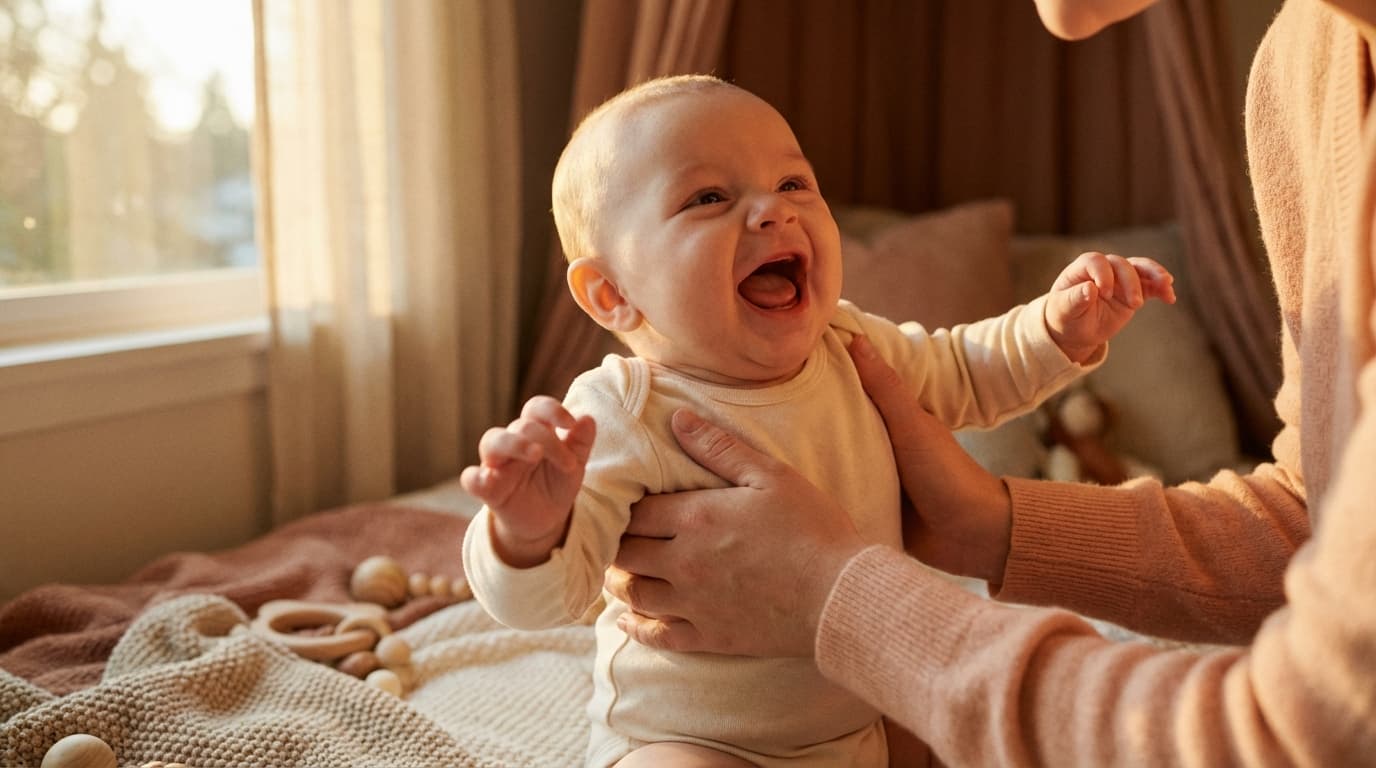
The first time your baby laughs, you will drop whatever you're holding. It doesn't matter if you're mid-sentence, mid-bite, or trying to leave for work. That sound stops everything.
It's also weirdly hard to describe. Not a giggle like an older kid. More like a surprised exhale that turns into a sound they didn't expect to make. Half of parents who hear it for the first time aren't even sure it happened.
When to Expect It
Most babies produce their first real laugh between 3 and 4 months old, according to the CDC. The CDC lists "chuckles" as a 4-month milestone and full laughing as a 6-month milestone.
But the range is wide. Some babies let out a laugh at 2.5 months. Others don't get there until 5 or 6 months and that's completely fine. Laughing requires a bunch of developmental pieces to come together: breath control, social awareness, the ability to process something as surprising or funny. That's a lot of wiring.
Before the laugh, you'll usually see:
- Social smiling (around 6-8 weeks), where they smile in response to your face or voice, not just gas
- Cooing and vocal play (2-3 months), testing out sounds, mostly vowels
- A sort of pre-laugh, a breathy "heh" or a squeal that's almost there but not quite
The laugh itself tends to show up after your baby has been cooing for a while. They're experimenting with their voice and at some point, a sound comes out that surprises both of you.
What Makes Babies Laugh
Baby humor is basically physical comedy. They don't get jokes, wordplay, or irony. They respond to things that are unexpected but safe.
The most reliable laugh-triggers for young babies:
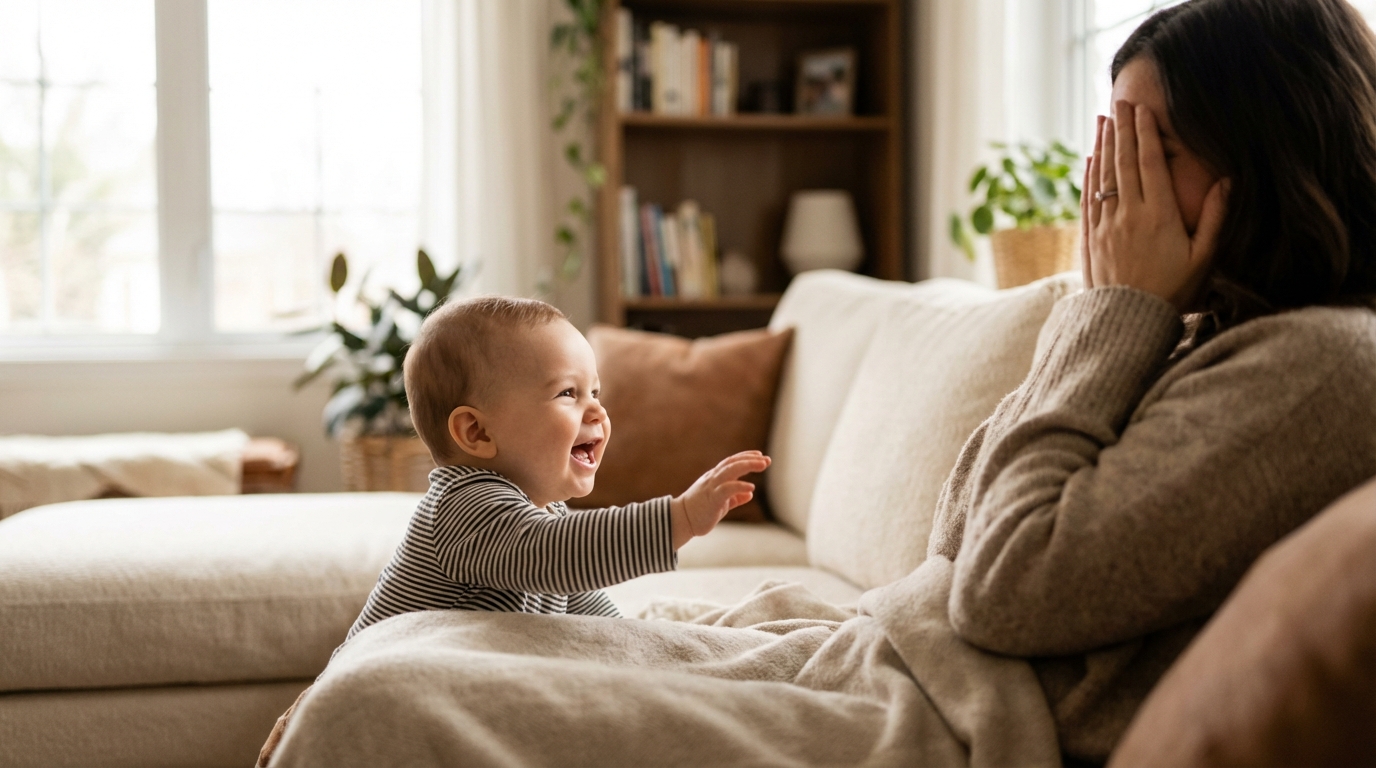
- Peek-a-boo. You disappear, you reappear. That violation of expectation is hilarious to a 4-month-old. Dr. Caspar Addyman, a developmental psychologist who ran the Baby Laughter Project at Birkbeck, University of London, found peek-a-boo was the single most common trigger for baby laughter worldwide.
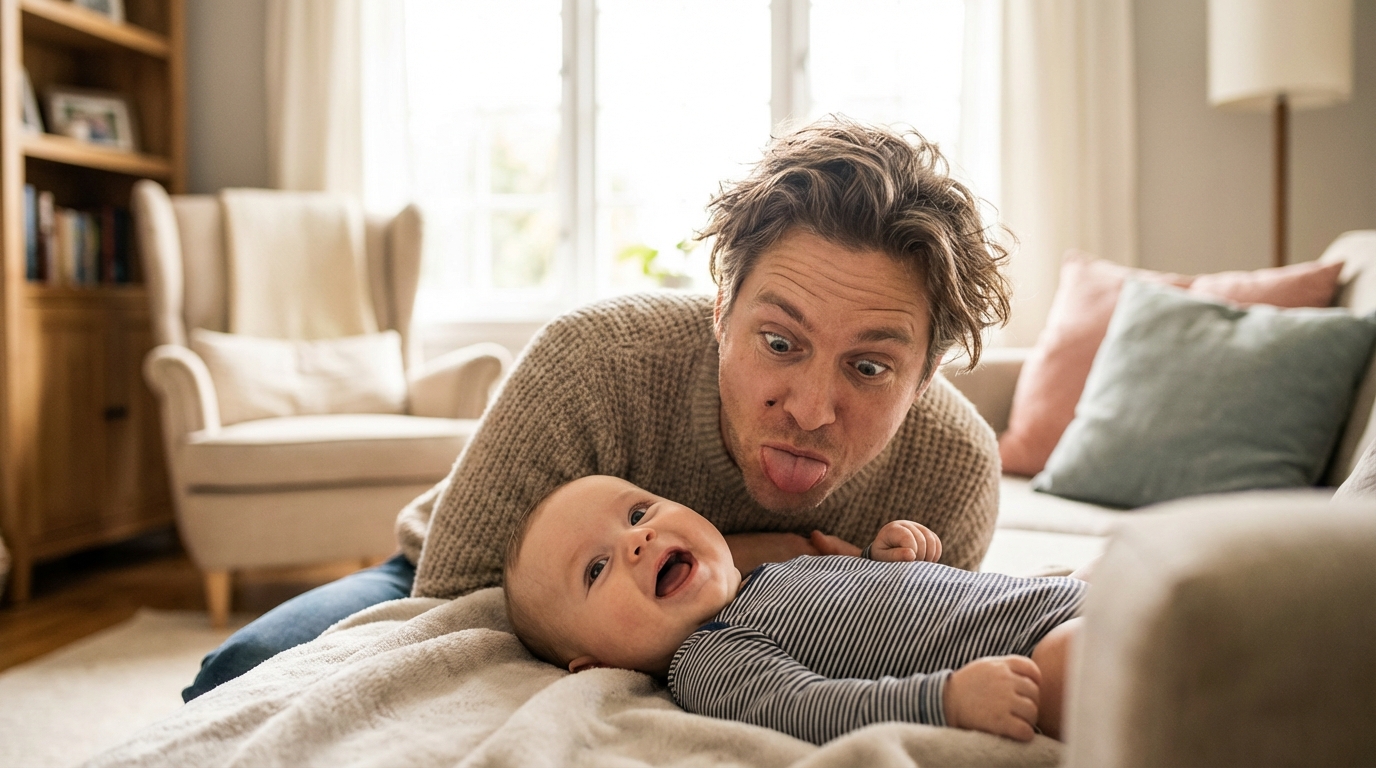
- Funny sounds. Raspberries on their belly, exaggerated sneezes, popping your lips.
- Tickling. Light, gentle tickling. Their skin is sensitive and overstimulation flips the switch from laughing to crying fast.
- Being lifted or bounced gently. That swooping stomach feeling. Same reason older kids love swings.
- Older siblings doing literally anything. Your baby will laugh at their sibling walking across the room before they'll laugh at your best material.
Why the First Laugh Matters (Developmentally)
Laughing isn't just cute. It's a sign that several systems are working together.
When your baby laughs, it means they can process something as unexpected (cognitive), recognize it as safe rather than threatening (emotional regulation), and produce a complex vocalization in response (motor control of the diaphragm, vocal cords, and breath). The American Academy of Pediatrics tracks laughter as part of social-emotional development, alongside skills like responding to their name and showing interest in other people.
It's also the beginning of social humor. Your baby is learning that making sounds gets reactions from you. When they laugh and you laugh back, that feedback loop is one of the earliest forms of conversation. They start doing things on purpose to get you to react, which is a lot of social processing for someone who can't hold a spoon yet.
What If Your Baby Isn't Laughing Yet
If your baby is 4 or 5 months old and hasn't laughed, don't spiral. The timeline is a range, not a deadline.
Some things that can affect timing:
- Temperament. Some babies are observers. They take everything in with a serious expression and save their reactions. They often hit other milestones on time but are just quieter about it.
- Premature birth. Use adjusted age for milestone expectations. A baby born 6 weeks early might not laugh until 5-5.5 months by calendar age, which is right on track.
- Overstimulation. Tired, hungry, or overwhelmed babies won't laugh even if you bring your best material. Try when they're fed, rested, and alert.
When to actually talk to your pediatrician: the CDC recommends checking in if your baby isn't smiling at people by 4 months or isn't laughing at all by 6 months. The absence of laughter alone isn't diagnostic of anything, but it can be one piece of a bigger picture your doctor can evaluate.
How to Get More Laughs
Once you hear that first one, you'll want it on repeat. A few things that work:
Match their energy. If your baby is in a calm, alert mood, start with gentle peek-a-boo. If they're already squealing and kicking, go bigger with raspberry noises and swooping.
Repetition is key. Babies find repetition funnier than adults do. The 14th game of peek-a-boo is just as hilarious to them as the first one. Their brains are still building the neural pathways that make prediction possible, so each round feels partly new.
Watch for "I'm done" signals. Turning their head away, fussing, arching their back. Overstimulated babies go from laughing to crying in seconds. When they look away, give them a break.
Let them see your face up close. Babies under 4 months can see most clearly at about 8-12 inches away, according to the AAP. Get close. Your face is their favorite thing to look at, and your expressions are the funniest thing in their world.
Recording the First Laugh
This is one of those milestones where the memory fades faster than you'd expect. You'll remember that it happened, but the specific sound, what triggered it, who was there. That gets hazy within months.
If you want to capture it, keep your phone accessible during alert, playful periods (after feeding, after a nap). But don't stress about getting it on video. A quick note in Aanvi, just the date, what caused it, who was in the room, is enough to bring the memory back years later. The app logs milestones alongside photos and videos, so even a text note next to a photo from the same week tells the full story. If you want to see which milestones come next, the Baby Milestone Tracker lists them by age.
The best approach: try to catch it on video if you can, but if you miss it, write down the details within a day or two while they're still fresh.
The Laughs Keep Changing
The laugh at 4 months is nothing like the laugh at 9 months. As your baby develops, their sense of humor actually evolves:
4-6 months: Physical comedy. Peek-a-boo, funny sounds, gentle roughhousing.
6-9 months: They start laughing at things that are "wrong." You put a sock on your head. You pretend to drink from their bottle. The fact that something is out of place is hilarious to them because they're starting to understand what's normal.
9-12 months: They begin making YOU laugh on purpose. Fake coughing, dropping things off the high chair and watching your face, making weird sounds and waiting for your reaction. This is intentional humor and it's a big developmental leap.
By their first birthday, your baby has gone from a reflexive "heh" to someone who can tell a joke, a physical, wordless joke, but a joke. That's a lot of cognitive growth packed into about eight months.
You won't get their first laugh on video. Almost nobody does. But you can write down what happened while it's still fresh: what sound you made, the look on their face, whether you cried a little. Aanvi keeps milestones, photos, and notes together in one place so those details don't disappear into your camera roll. Try it free for 7 days.