

Most parents who try writing letters to their baby get through one, maybe two, and then the notebook goes in a drawer. Not because they don't care, but because sitting down with a blank page at 10pm when your brain is mush is a genuinely hard thing to do.
The problem is usually not motivation. It's not knowing what to put in the letter. So this is a practical guide to that part.
Pick your moments (and don't overthink it)
You don't need to write monthly. You don't need to write on every birthday. Some parents set a schedule and that works for them. Others write when something hits them and that works too.
Good times to write:
- Their birthday (obvious, but it works)
- The day they do something for the first time: crawl, walk, say a real word
- A random Tuesday where they did something so specific you know you'll forget it by Thursday
- When something big changes in your life or theirs
Bad times to write: when you feel like you should. Guilt letters aren't fun to read.
What to actually say
This is where most people freeze. The letter feels like it needs to be profound. It doesn't.
The best letters aren't grand declarations of love. Your kid already knows you love them. The best letters are full of stuff they can't possibly remember on their own.
Write down what they're obsessed with right now. At eight months, maybe it's pulling every sock out of the laundry basket. At two, maybe it's a specific episode of a show they've watched 40 times and you can recite from memory. The sock detail is what makes it worth reading in 20 years, not "you bring light to our lives."
Some concrete things worth putting in a letter:
- What they ate for breakfast and whether any of it ended up on the floor (probably yes)
- The weird nickname you have for them that you'll probably stop using by next year
- Something they're scared of that's totally harmless
- The face they make when they're concentrating
- What your days actually look like together, hour by hour
- Something about the world right now: what's on the news, what season it is, what your street looks like out the window
The last one matters more than people think. Your kid reading this in 20 years will want to know what the world felt like, not just what they were like.
What to leave out
Skip the advice. "I hope you'll grow up to be kind and brave" sounds nice, but it's not specific to your child. It's something anyone could write to anyone. Twenty years from now, a letter full of life lessons reads like a greeting card. A letter about how they used to call helicopters "chop chops" reads like a time machine.
Also skip the apologies. "I'm sorry if I ever let you down" is a heavy thing to drop on someone opening a letter. Keep it to what's happening now, not hypothetical future regrets.
Length doesn't matter
A letter can be three sentences. It can be three pages. The only rule is that it should say something real. One honest paragraph beats two pages of filler.
If long-form writing isn't your thing, try a list format:
Things that are true about you at 14 months:
- You say "more" for everything, including things you haven't tried yet
- You love the dog next door and scream when we walk past that house
- You fell asleep in the shopping cart last week and a stranger took a photo because it was that good
- Your favorite book is the one with the duck. We've read it maybe 300 times.
A list like that is a perfectly good letter. Nobody's grading these.
Where to keep them
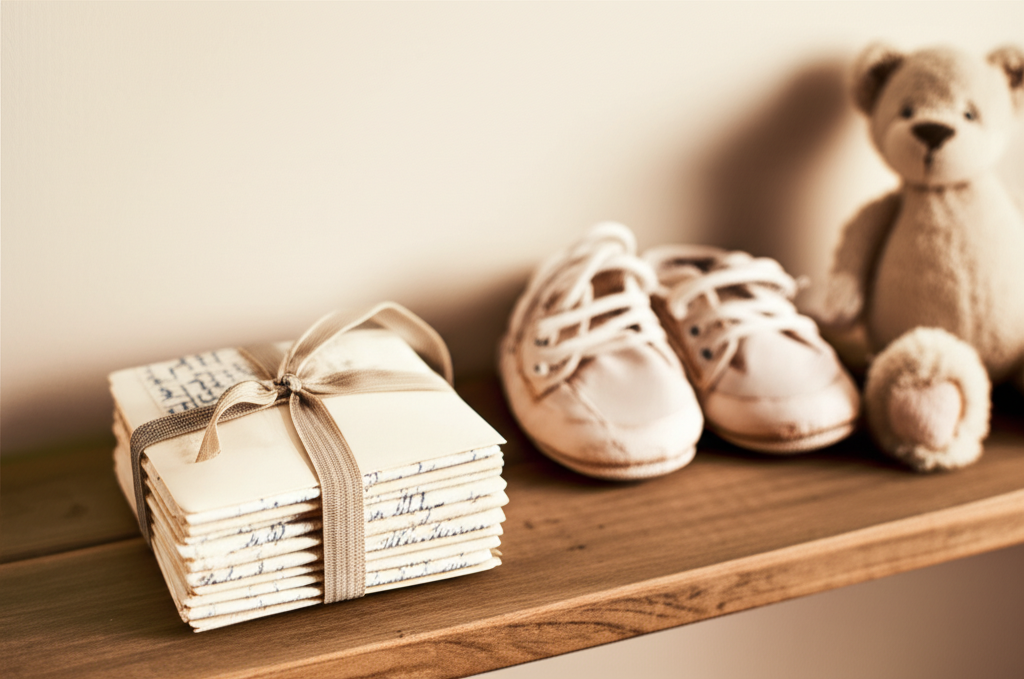
The classic move is a box or a journal. Both work. The risk with paper is the same risk with everything paper: water, moves, the passage of time.
Some parents create an email address for their child and send letters there. Clever, but email providers don't guarantee accounts stay active for 18 years. Worth having a backup.
A better approach is both. Write it somewhere digital where it won't get lost, and print the ones that matter for the physical keepsake box. Aanvi can work as that digital layer since it keeps text entries on a timeline alongside photos and milestones, so the letter lives next to the moment instead of in a separate notebook.
When they'll actually read them
You don't know when (or if) your kid will want to read these. Some kids are sentimental at 12. Others won't care until they have kids of their own. The letters aren't on a deadline.
But you'll probably want to read them yourself. Parents who've been writing letters for a few years say the same thing. You forget fast. The letters end up being as much for you as for them, a record of a version of your family that doesn't exist anymore.
Which, honestly, might be the best reason to start.
If you want a place to start, write one sentence about what happened today. Just one. You can always add more later, or not. The letter's already done.