
Naming a baby should be straightforward. You have roughly nine months, two people with opinions, and a few hundred thousand names in the English language alone. And yet most couples describe it as one of the most stressful parts of pregnancy, right after the actual medical stuff.
The problem isn't a shortage of names. It's that every name you consider gets filtered through about twelve different objections. The kid from third grade. The weird ex. The initials spelling something unfortunate. The fact that it's suddenly the most popular name in the country and you wanted something at least slightly uncommon.
So how do you actually narrow it down and agree on one?
Start wider than you think
The biggest mistake couples make is starting with a short list. You each bring five names to the table, none of them overlap, and now you're negotiating from a position of mutual disappointment.
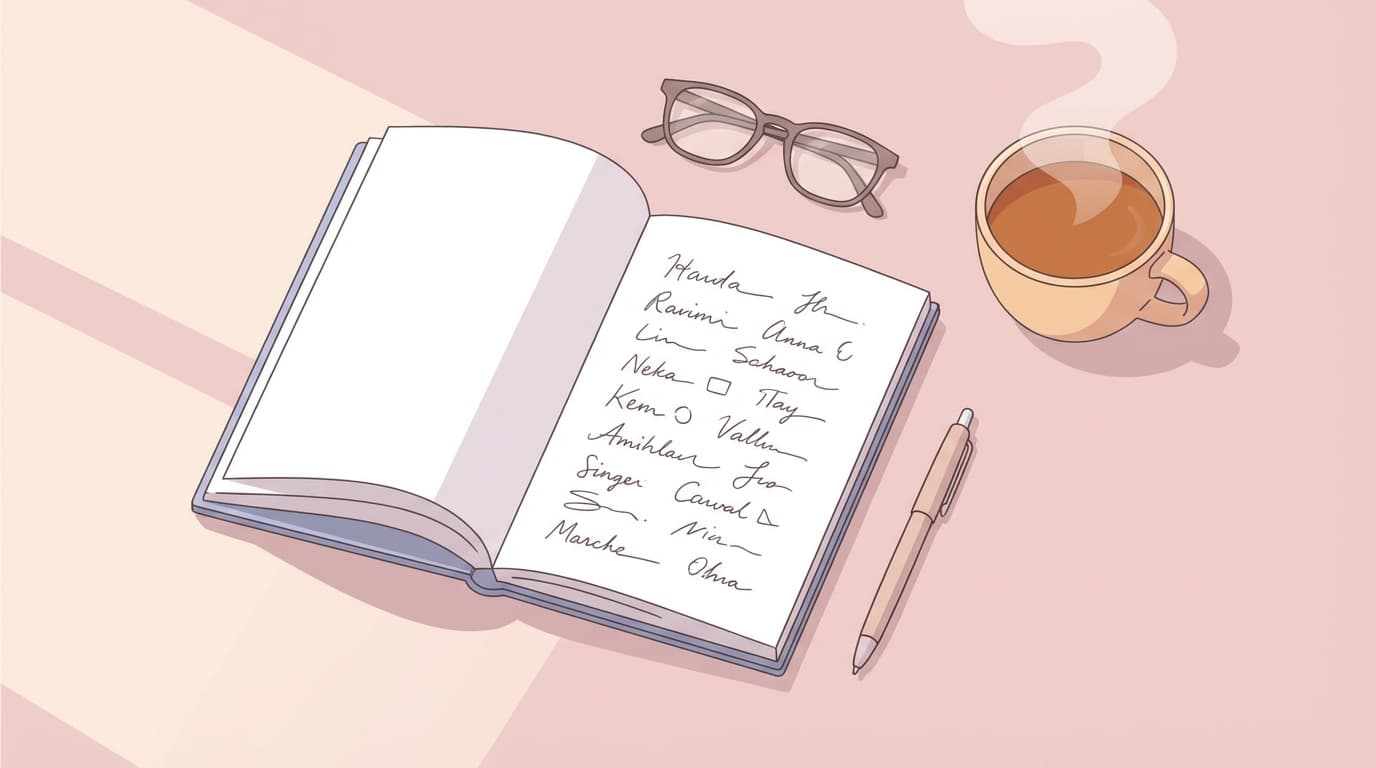
Instead, start with a long list. Fifty names each if you can manage it. Pull from everywhere. Family trees, name meaning databases, characters from books, names you heard once and liked the sound of. The Baby Names tool is good for this stage because you can search by meaning, origin, or letter and build a list quickly without scrolling through 9,000-entry websites.

The goal isn't to find The Name immediately. It's to have enough options that you can afford to eliminate freely without running out. Parents who start with a list of three names get stuck. Parents who start with forty find something by process of elimination.
The tests worth running
Once you have a working list, put every name through a few practical checks that have nothing to do with whether you "love" it.
Write out the full name. Say it out loud. Say it fast, the way a teacher taking attendance would. Some combinations that look fine on paper have awkward rhythms or accidental rhymes when spoken. "Emily Lee" looks fine. Say it five times fast and it turns to mush.
Write out first, middle, and last initials. A surprising number of otherwise good name combinations produce initials like ASS, BRA, or DIE. This seems minor until it's monogrammed on a backpack.
Then try the playground test. Imagine yelling this name across a crowded park. Names with strong consonants and clear vowels carry. Soft, multi-syllable names get swallowed by background noise. You will be yelling this name a lot.
Google the full name in quotes. You're looking for anyone famous or infamous sharing the name. A shared name with a beloved musician is fine. A shared name with someone in the news for the wrong reasons is worth knowing about.
And one that parents often skip: does the name work for an adult? Your baby will eventually be a 35-year-old applying for jobs. You don't have to pick something conservative. But the name should sound like a real person, not a nickname that only works on a toddler.
Popularity: does it actually matter?
According to the Social Security Administration's baby name data, the top 1,000 names cover roughly 71% of all babies born in the U.S. in a given year. The number-one name in any year typically accounts for less than 1% of all births. That means even the most popular name in the country is given to fewer than 1 in 100 babies.
For context: Olivia and Liam have been the most popular names for six consecutive years through 2024. Despite that, the odds of your kid being one of three Olivias in a class are much lower than they were when Jennifer dominated the 1970s or Jessica owned the 1980s. Name distribution is more spread out now.
So if you like a popular name, the statistical argument against it is weaker than most people assume. And if you want something uncommon, you don't have to go to the bottom of the list. Anything outside the top 200 is unlikely to be shared with a classmate.
The partner disagreement problem
The most common scenario: one person has a name they've loved since they were 14, and the other person has a strong negative association with it. The veto is reasonable (you shouldn't have to think of your partner's terrible ex every time you say your child's name) but the grief is also real.
A few strategies that help:
Each person gets a fixed number of no-questions-asked vetoes. Three is usually enough. These are names you refuse for personal reasons, no justification required.
Use a shared list app or spreadsheet where you each independently rate names on a 1-5 scale, then sort by combined score. This prevents the dynamic where one person shoots down names verbally and the other stops suggesting them.
Consider giving one parent the first name and the other the middle name. This works better than it sounds, especially if both people feel strongly about different names.

If you're stuck, the Name Combiner tool can generate blended names from both parents' favorites. Some results are silly, but occasionally one lands. If you're in that fun, speculative, pre-baby phase, the Baby Eye Color Predictor is the same kind of harmless guessing game.
Cultural and family names
Family naming traditions vary widely. Some families expect the firstborn son to carry his father's name. Some cultures choose names based on the day of the week, the season, or a religious calendar. Some families have a pattern (all names start with the same letter, or all names come from the same origin).
These traditions are worth honoring if they matter to you, and worth ignoring if they don't. The pressure to use a family name you actively dislike is one of the most common sources of naming conflict. A middle name is a good compromise position: the family member is honored, and the kid goes by a first name the parents actually chose.
One practical note: if you're choosing a name from a language or culture different from where you live, consider how it will be pronounced by people who don't speak that language. This isn't a reason not to use it. It's a reason to be prepared for mispronunciation and decide in advance how you feel about that.
When to stop deliberating
Some couples have the name picked before the first ultrasound. Others are still debating in the hospital room. Both are fine, and hospitals are used to it. In most U.S. states, birth registration is required within a few days to 10 days, though the hospital typically handles the paperwork before discharge. So there's no real pressure to decide in the delivery room itself.
That said, deciding under pressure with a newborn in your arms and sleep deprivation setting in is not ideal. If you can narrow it to two or three finalists before the due date, you'll be in good shape. Some parents find that seeing the baby helps them decide between their top picks. Others find it makes the decision harder because the baby doesn't "look like" any name yet (they look like a potato, which is normal).
The name doesn't have to be perfect
The name you pick will become your kid's name. Within a week of using it, it will stop feeling like a decision and start feeling like a fact. The anxiety about whether you chose The Right One fades fast once the name is attached to a real person who smiles at you.
If you want to remember how you landed on the name, a baby memory app like Aanvi lets you save notes on a timeline alongside photos and milestones, so the whole decision story is in one place instead of buried in old text threads. Kids ask about this stuff eventually.
If you're still deep in the brainstorming phase, the Baby Names tool lets you search by meaning, origin, and starting letter. It's faster than scrolling through the SSA database directly, and you can build a shortlist without opening twelve tabs.