
The one keepsake project that actually gets finished
Baby scrapbooks tend to die around month four. The memory book has a footprint on page one and then blank pages. The monthly photo series skipped months seven and eight.
Time capsules work because they don't require ongoing effort. You gather stuff, seal the container, and you're done. One afternoon and your kid gets to crack open a box of 2026 on their 18th birthday.
Container first
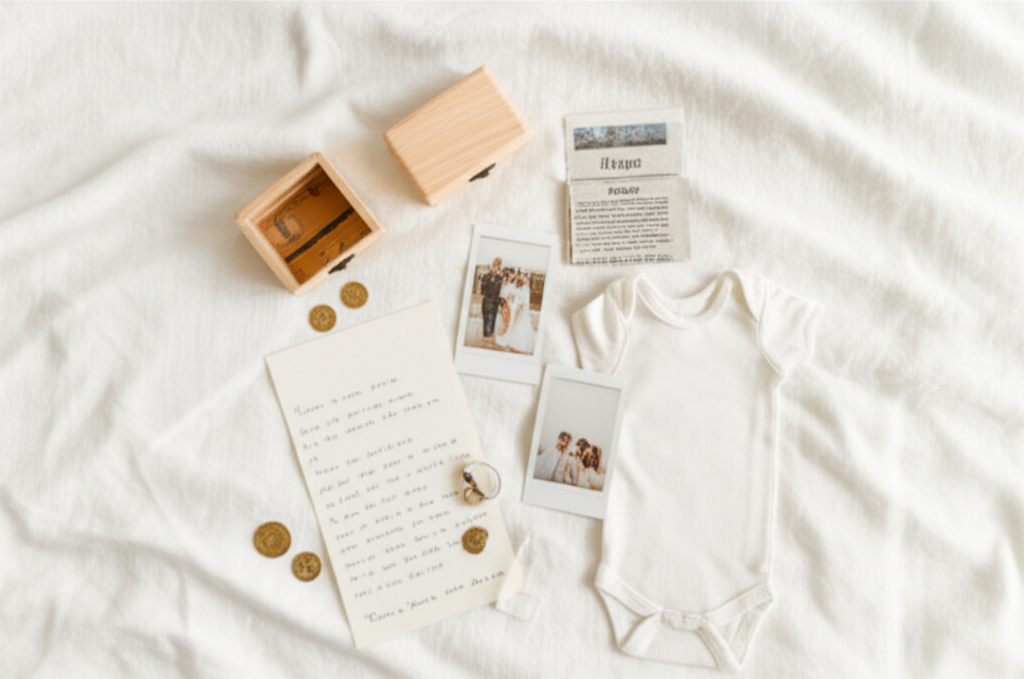
It needs to last 18 years, minimum. Cardboard won't make it. Plastic bins with tight-fitting lids work. Metal tins work. If you want something genuinely indestructible, military surplus ammo cans are waterproof and will survive basically anything.
Put a label on the outside with the date sealed and the date to open. Not inside. Outside. Your 18-year-old shouldn't have to open it to find out when to open it.
What to put in it
The letter
This is the most important item. Everything else is decoration.

Don't try to be poetic. Write about what's actually happening: your job, your apartment, what your days look like. Write about who your baby is right now. What makes them laugh. What they refuse to eat. The face they make when the dog walks in. The specific stuff is what holds up over time. "We love you so much" is nice but it's the same thing every parent writes. "You scream every time we put you in the car seat but fall asleep within three minutes" is something only your kid had.
Write it by hand if you can manage it. Handwriting is personal in a way that typing isn't, and your kid gets to see what your handwriting actually looked like.
Some starting points if the blank page is intimidating:
- What surprised you about becoming a parent
- What your baby's personality is like right now
- Something you hope for them
- What your family looks like today
Snapshot-of-the-world stuff
- A newspaper or magazine from their birth week. Not for the headlines, but for the ads, the prices, the things people cared about. A gallon of milk will cost something wildly different in 2044.
- A list of current prices: rent, gas, a cup of coffee
- The top 10 songs the week they were born
- A takeout menu from your go-to restaurant
- A few coins from their birth year
The personal stuff
- A printed photo of your whole family. Not just the baby. You, your partner, the house, the car. The everyday backdrop becomes fascinating with enough time.
- The outfit they wore home from the hospital (wash it)
- Their hospital bracelet if you still have it. If you don't, skip it.
- Screenshots of the text messages announcing the birth
- Your handwritten answers to: "What are you most worried about?" and "What are you most excited about?"
What to leave out
Trending toys and branded merchandise feel dated in five years, not meaningful in 18. Anything that will rot, mould, or leak (food, flowers, liquids) is a bad idea. Generic greeting cards that say "Welcome Baby!" say nothing. If you're going to include a card, write your own words in it.
The USB drive problem
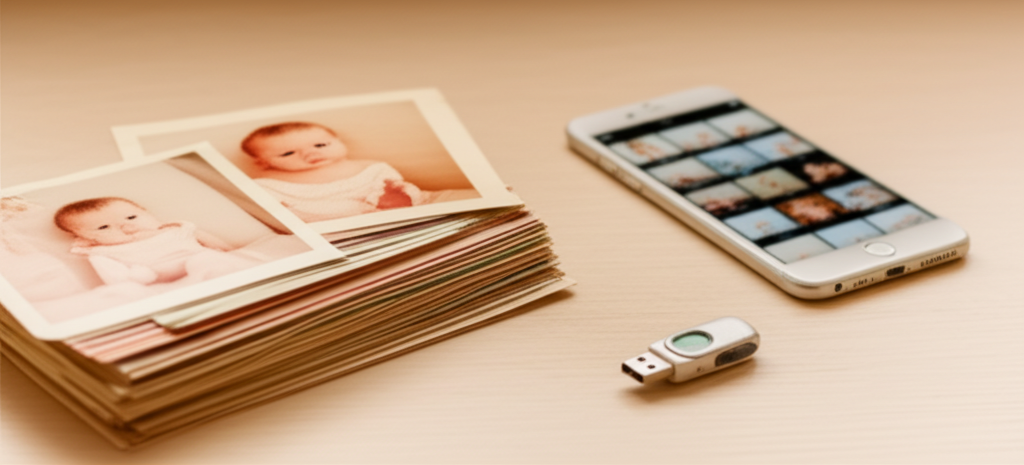
There's a decent chance USB ports won't exist in 2044. Floppy disks, zip drives, CDs. They all had their moment and they're all useless now.
If you're including digital files (videos of their laugh, their weird 3am screeching, the babbling), put them on a USB drive AND upload them somewhere. Cloud storage, email them to yourself, save them in a family photo app. Belt and suspenders. A baby memory app like Aanvi works well for this.
Better yet, print the important photos. Paper doesn't need a driver or a software update. A printed 4x6 will be perfectly readable in 50 years.
When to do it
Two good windows.
Right after birth, while you're still in nesting mode and feeling reflective. The newspaper is current. Channel that energy into 30 minutes of gathering stuff and writing a letter.
Around the first birthday. You have a full year of context. You know their personality. You have stories. A first birthday party is a natural moment to seal the capsule with family watching.
Don't wait for the perfect time. That day doesn't come and you end up doing it never.
Where to keep it
Attics get hot. Basements get wet. Garages get both.
Put it on a closet shelf in a climate-controlled room, inside a larger storage container, or in a safe deposit box if you're serious about it. Wherever it goes, tell someone else where it is. You will not remember in 2044.
Physical and digital together
A box in a closet captures one moment. But the first year has hundreds of small moments between the sealing and the opening: the first crawl, the weird foods they liked, the faces they made. Those don't fit in a box.
Aanvi works well as the digital companion. Photos and milestones on a timeline, shared with family, searchable later. The physical capsule is for the big reveal on their birthday. The digital record is for everything in between.
Wondering what milestones to watch for this month? Check out the Milestone Tracker.