
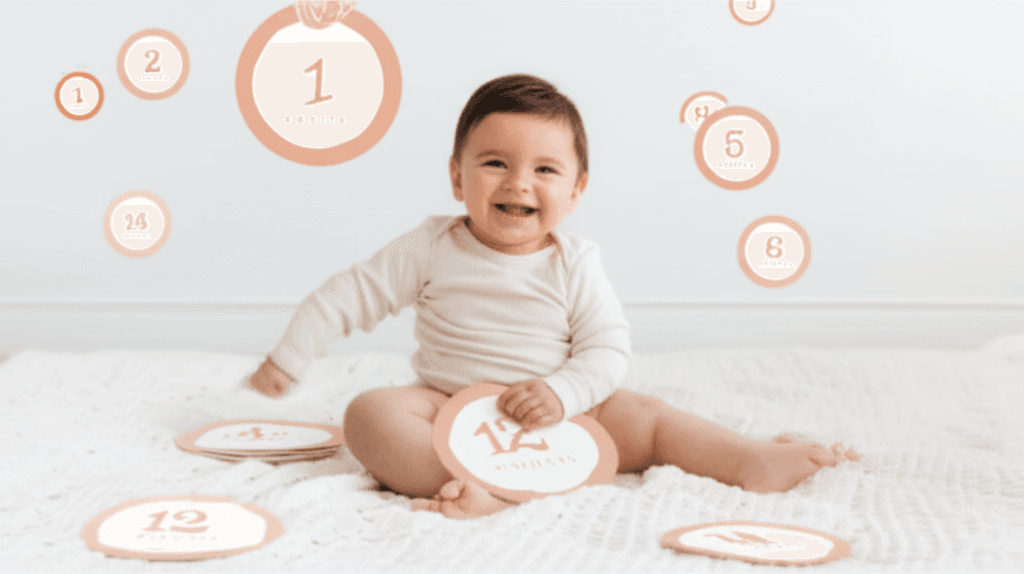
Twelve months is a long time
A year from now, the tiny human currently sleeping on your chest will be standing up, pointing at things, and possibly saying a word that sounds like "dog" but means everything. The amount of change that happens between birth and the first birthday is absurd. No other year of life comes close.
This is a rough guide to what happens when. Rough, because babies don't read development charts. Some walk at 10 months. Some don't bother until 15. Both are fine. This isn't a checklist to stress about.
Month 1-2: The potato phase
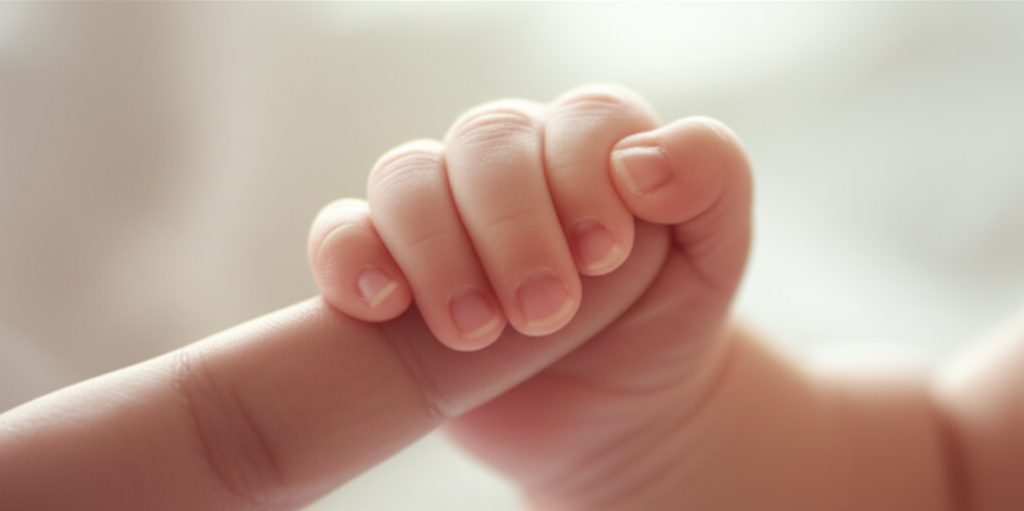
Your baby can't do much yet. That's okay. They're working on it.
In these first weeks, they can see about 8-12 inches in front of their face, which is roughly the distance to yours during feeding. Not a coincidence. They'll grasp your finger if you put it in their palm (reflex, not affection, but take the win). Loud sounds will make them startle. And somewhere around 6-8 weeks, you'll get the first real social smile, the one that's clearly directed at you and not just gas.
Mostly, though, this phase is about holding them, talking to them, and doing a lot of skin-to-skin. The bonding matters more than any activity you could plan.
Month 3-4: They figure out they have hands
This is when it starts getting fun. Your baby will discover their own hands and stare at them like they've just found something extraordinary. Which, from their perspective, they have.
- Cooing and gurgling. Early conversation attempts. They're not saying words, but they're practising the sounds.
- Head control during tummy time. Still wobbly, but getting there.
- Reaching for things. Batting at toys. Missing, mostly.
- The first real laugh. Not a smile, an actual belly laugh. You will do increasingly ridiculous things to hear it again.
Give them plenty of tummy time even if they hate it (they probably hate it). Hold colourful things near them. Narrate what you're doing. They understand nothing but they're absorbing the rhythm of language.
Month 5-6: Rolling, grabbing, tasting everything

Rolling over is the first real mobility milestone and it changes the game. You can no longer put the baby on the bed and walk to the kitchen. The floor is now their domain.
Around 6 months, most pediatricians give the go-ahead for solid foods. "Solid" is generous. It's mostly puree getting smeared on faces. Introduce one thing at a time, watch for reactions, and accept that about 80% of it will end up on the bib.
They're also starting to recognise familiar faces versus strangers, which means you might get some crying when grandma visits after a few weeks away. Stranger anxiety is annoying but it's actually a sign their brain is doing exactly what it should.
Month 7-8: Crawling (or some version of it)
Some babies do a textbook hands-and-knees crawl. Some army-crawl on their bellies like tiny commandos. Some scoot on their butts. Some skip crawling entirely and go straight to pulling up on furniture. All of these count.
Babbling picks up here. You'll hear "mama" and "dada" sounds, which feels like a word but usually isn't directed at anyone specific yet. Object permanence kicks in too, meaning they now understand that a toy still exists when you cover it with a blanket. This is why peek-a-boo suddenly becomes the greatest game ever invented.
Baby-proof seriously at this stage. They will find the one outlet cover that's loose. They will pull on every cord. They are fast and they have no fear.
Month 9-10: Standing, cruising, opinions
Your baby is pulling up on everything: furniture, your legs, the dog. They're "cruising" (walking while holding onto something) and starting to develop a pincer grasp, which means they can pick up individual Cheerios between their thumb and forefinger. This is a bigger deal than it sounds. Fine motor skills are building fast.
They wave bye-bye. They clap. They point at things they want. Communication is getting real, even without words.
Month 11-12: The grand finale

First steps might happen here, or they might not happen for another few months. The range on walking is huge (9 months to 18 months), and it says nothing about your child's intelligence or athleticism. Some kids are just more cautious.
What you'll probably see by 12 months: 1-3 real words beyond "mama" and "dada." They can follow simple instructions like "give me the ball." They have clear preferences about food, toys, and people. They're starting to become an actual tiny person with opinions.
Read to them every day if you can. Point at pictures and name things. They're building vocabulary even if they can't say the words yet.
When to bring it up with your doctor
Every baby has their own timeline. These benchmarks apply to full-term babies. If your baby was born premature, use their adjusted age. Your pediatrician screens for these at every well-child visit.
Flag it if:
- No eye contact by 3 months
- No reaction to loud sounds
- No babbling by 7 months
- Can't sit with support by 9 months
- No interest in moving by 12 months
None of these automatically means something is wrong. But early intervention, when it's needed, makes a real difference. There's no downside to asking.
Keeping track of it all
The first year has so many small moments that it's hard to remember what happened when. Was the first crawl at 7 months or 8? When did they start clapping? You think you'll remember. You won't.
Aanvi lets you log milestones with dates and photos on a single timeline, so you're not trying to piece it together from your camera roll six months later.
Want to see where your baby falls on the growth charts? Try the free Growth Percentile Calculator, see what clothing size comes next, or estimate their adult height.